


Wings of Peace
THE CALL: 2025-2026 | 8 MINUTE READ
CONNOR OWEN, STORYTELLING PARTNER
Guiding Scripture
7 Where can I go from your Spirit?
Where can I flee from your presence?
8 If I go up to the heavens, you are there;
if I make my bed in the depths, you are there.
9 If I rise on the wings of the dawn,
if I settle on the far side of the sea,
10 even there your hand will guide me,
your right hand will hold me fast.
11 If I say, “Surely the darkness will hide me
and the light become night around me,”
12 even the darkness will not be dark to you;
the night will shine like the day,
for darkness is as light to you.
God’s presence. Scripture says we can’t flee it. He will guide us and hold our hands. And His presence is easy to see in the stories we tell at WGM.
Stories of redemption; generational change; broken addiction; salvation received; baptisms; churches being planted. In short: the stories where God moved in mighty ways.
Is His presence the same in stories without a happy ending?
But is His presence the same in stories without a happy ending? Scripture says it’s so. Yet, we don’t often tell those stories because we find it hard to reconcile that God is in the room when bad things happen. When good people die too soon. When disease strikes the seemingly healthy. Or when a ministry comes to an end.
There is a danger in telling only positive, victorious stories. We forget that the missionary journey is fraught with hardship. Loss. Defeat. Anguish. Failure. Redirecting (and redirecting again). Arrests. Missed birthdays, births, deaths, anniversaries.
How, in those moments, do we view God? Do we believe He’s actually present? Or do we think maybe we missed Him somewhere, or that He forgot to come along for the journey?
Do we really believe that when a ministry ends, God was there? Do we not find ourselves asking—no, shouting—“How could you let that happen?! Where are you?!”
Stories that lack a happy ending are real. We don’t love to tell them. But back in 1998, a story like this occurred in the jungle of Bolivia. It’s a story that still isn’t over. It’s a story we’d rather not talk about, because, quite frankly, we don’t have human language for it—only scriptural language.
This story is an attempt to find language for how we reconcile with the fact that God is with us at all times. But sometimes people He loves—the best of the best people, the ones who fight for the marginalized and give it all up—lose it all.
Wings of Peace Ministry
After the second World War, technological advances made spreading the Gospel easier. WGM was one of the first mission organizations to use small-engine airplanes to reach jungle villages. In 1952, Jonathan Tamplin officially began WGM’s aviation ministry called Wings of Peace. Jonathan used this ministry to fly over the jungles of Bolivia to share the Gospel with unreached people groups.
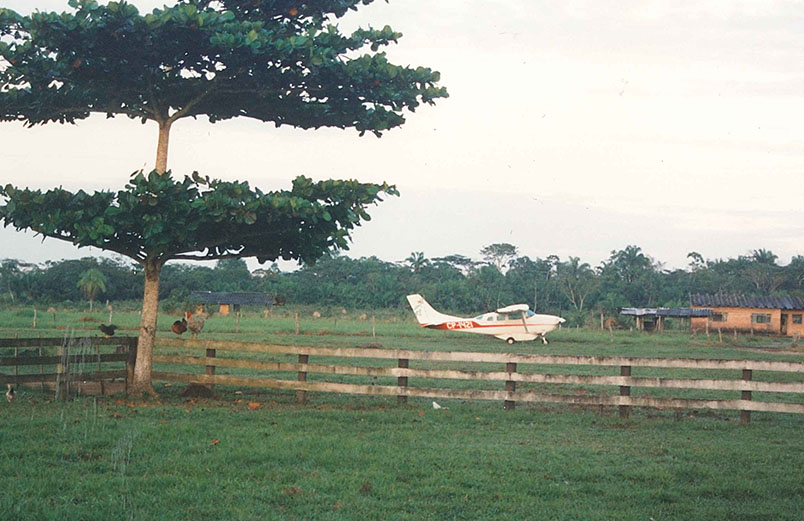
Wings of Peace plane looking at home in a field as the Bolivian livestock
These planes would deliver supplies, provide transportation, be emergency flights in life and death situations for Bolivians and missionaries, and most importantly: provide evangelistic flight opportunities into the most remote jungle settlements.
The ministry lasted until 2008. But in 1998, ten years before its ending, an event occurred that changed the ministry forever. And it changed those involved with the ministry.
Wings of Peace is Missing
Yucumo, Bolivia. September 28, 1998.
WGM missionaries John and Masako Trosen, with their children, Isaiah and Sophia, left on the Wings of Peace airplane from Santa Cruz, Bolivia. Newlyweds Johnny and Lucy Mamani and Pastor Juan Carlos Suazo of the World Gospel Church accompanied them on their ministry flight.
All accounts received show that their time in the jungle village was successful in building relationships and sharing the Gospel. John loaded up the plane along with all the passengers and began the journey back to Santa Cruz, where they lived. Their flight home, though, turned tragic at some point between 12:56 p.m. and 1:11 p.m.
Every fifteen minutes, Wings of Peace pilots were required to check in with those on the ground. John was meticulous—never missing a check-in. John checked in at 12:56 p.m. On the dot, as John always did. But at 1:11 p.m.—his next expected check-in—there was only silence. And that silence has never ended.
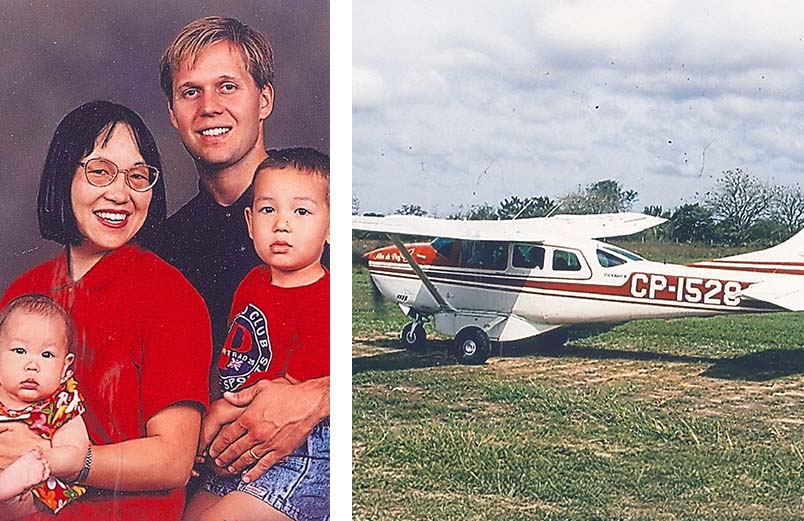
John Trosen and family. Pilot of WOP #6; missing in action
Search-and-rescues were done for months, even years. But the plane was never found. The feelings, all these years later, are still hard and real. But in the stories of what occurred, we find that there is still a God who is present in the hard reality that this Wings of Peace plane and its seven passengers have never been found.
God’s Presence
Back to the Psalms. The book that gives us language when we have none: “Where can I go from your Spirit? Where can I flee from your presence?” (Psalm 139:7).
What strikes me most is the trust from those who experienced deep hurt in this situation. They truly believe we serve a God who abides. It’s these stories that strengthen my own faith—seeing those who’ve gone before truly remain in Jesus, even in the hardest of circumstances. Even when it feels like God’s presence is completely missing.
This story is an attempt to find language for how we reconcile with the fact that God is with us at all times.
But we know that God’s presence is never missing. In the Great Commission, Jesus, of course, calls us to “make disciples of all nations, baptizing them in the name of the Father and of the Son and of the Holy Spirit, and teaching them to obey everything I have commanded you” (Matthew 28:19–20). And in the missions’ world, we love those verses. I wonder, though, if we should pay closer attention to the last part of Jesus’ words to His disciples:
“And surely I am with you always, to the very end of the age.” (Matthew 28:20)
There it is: God is with us, always, until the end of the age.
In the midst of darkness and hardness and what feels like earthly failure as we share His Gospel, we can rest assured, He is with us.
First-Hand Accounts
Below are some first-hand accounts from the day the Wings of Peace plane went missing, from missionaries like Rick and Lori Lampen, David and Cathlene Strong, Ron and Bernice Farnum, and Dennis and Twana Johnson. In these accounts, you’ll be reminded that God is present, no matter what.
Rick and Lori Lampen | Flying with Wings of Peace | A Ministry Story
Ascensión, Bolivia. 1994.
It was a perfect day to fly. The sun was out, the wind was blowing hot air into the hangar.
There were eight of us loading up the plane to go off for a trip we’d waited so long for: our pastor, his wife, and their two children, Rick (my husband), me, and our three-year old our daughter, Kaylynn.
Our pilot, Tom Leininger, was meticulously weighing everything and everyone, which I always hated (and we never got to know how much Tom weighed).
Knowing who weighed what, each of us was assigned a specific seat so that the weight was distributed evenly. My daughter, Kaylynn, was on my lap, and off we went.
It was perfect. It was beautiful. From the airplane, you just saw a jungle. You couldn't tell that there were settlements underneath all those trees. And we soon landed on the airstrip and were greeted by the people.
Once we got off the plane with all our stuff, Tom quickly started the plane and took off, leaving us in the village.
It was an eerie sound, listening to that plane engine disappear into the jungle.
I thought, Oh boy, yeah, we're here. We're here to stay.
The day was Friday. Tom was supposed to come back and get us on Sunday afternoon.
Soon we were wrapped up in all the activities we had planned. We were going to go over and visit another little settlement of people. There was a service at church in their little community building.
But then Saturday came. And with it: an awful cold front. It was terrible. The temps dropped down to like the low forties. We were wet, cold, and miserable. It was then that it dawned on me: Oh boy, we're not getting out of here tomorrow.
In Bolivia, these weather systems settle in for a while. And this was a bad one.
Monday passed. The weather was too bad. Nobody was going anywhere. We were out of clothes. Kaylynn was sick.
Tuesday morning came. And over the radio, we heard there was a chance that Tom might be able to get to us. So, I started praying. And thankfully, God answered our prayers.
That afternoon, we heard the plane. Tom was buzzing us— flying low over the village—to tell us to meet him at the airstrip.
When we got to the airstrip, Tom was in a hurry. He also needed the men to clear out more room at the end of the little airstrip because it was too short, and the plane was heavy. Because we were in a hurry, goodbyes were rushed.
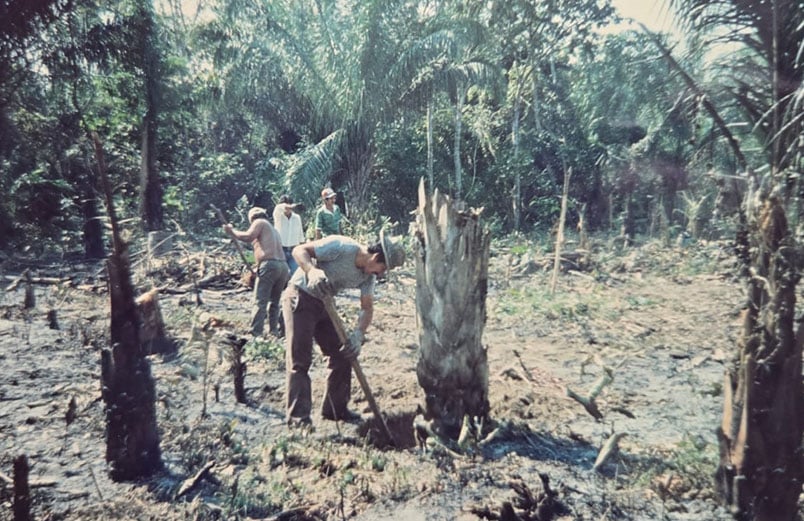
Several men clearing the runway for the WOP plane.
As we strapped in, Tom asked someone to pray. We did. Quickly. And sincerely.
Tom cranked up the engine and positioned the plane for takeoff. I saw him set his shoulders. And I knew—we were doing this. He jammed the throttle as hard as he could.
About halfway down the airstrip, I started to think: I could run faster than we’re going! We're not getting off the ground. Come on, come on. Oh no! We should turn around. We’ve got to start this one again.
But nope. Tom was serious. Those shoulders were set, and he had no intention of stopping.
Then, slowly and steadily, the nose of that plane took off. We missed the taller grasses at the back of the runway, and the Lord lifted us over that wall of jungle trees that was at the end of that strip. We all breathed a breath of relief, heading back home.
As far as I know, no one responded to the message of salvation while we were there, except for one little boy. And that was the pastor's son that we had taken with us. Today, he's a graduate of Bolivian Evangelical University, and he's on the pastoral team of one of our local churches.
So if no one there responded to the message, why go? And what was Wings of Peace and its purpose?
What's so special about Wings of Peace is that they planted the Word and they shared God's love. And most of all, they gave the possibility of having a presence with people who could very easily just be forgotten.
The fruit of what we planted, we’ll never know entirely. But we do know that many people in the area served by Wings of Peace are now serving the Lord in churches, schools, ranches, and their own families. The seeds planted for Jesus continue to grow.
Daudi and Cathlene Strong | An Ordinary Day Turned Upside-Down
Santa Cruz, Bolivia. Monday. September 28, 1998.
It was a routine day for the Strong family in Bolivia. Our son, Nick, went to school. David (Daudi) ran errands for the Wings of Peace ministry. And Cathlene worked at the mission office.
Returning home in the early afternoon, intending to work at the house, we received a phone call that would change our routines for weeks to come.
The airplane, Wings of Peace, was missing.
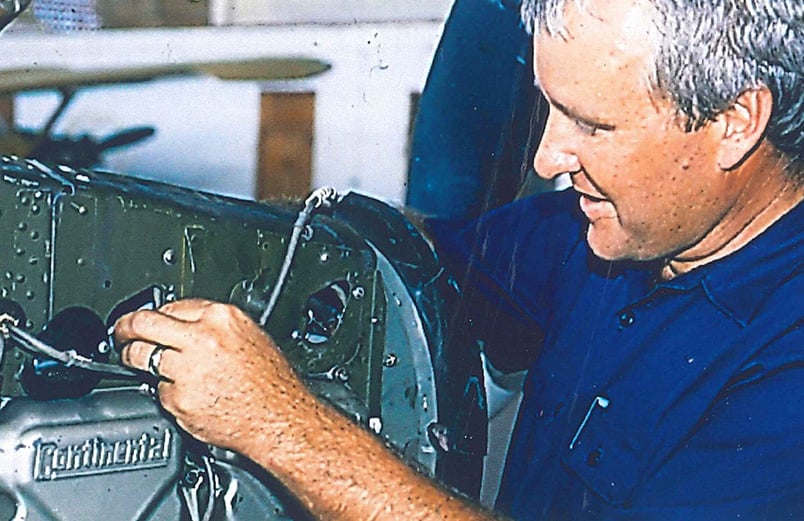
Daudi Strong working on one of many planes he serviced
John Trosen's plane had not arrived in Santa Cruz as scheduled from a ministry trip. John had taken his wife, Masako, and their two children, Isaiah and Sophia; a Berea Bible Seminary couple, Johny and Luci Mamani; and a local pastor, Juan Carlos Zuazo, to the village of Yucumo for a weekend of special services.
Routine check-ins every 15 minutes on the flight were something John never missed. He checked in at 12:56pm, an hour and fifteen minutes into the flight. Fifteen minutes later, there was no check-in. And again 15 minutes after that. After minutes turned into hours, we realized something was wrong.
Plans for search and rescue efforts were immediately discussed, but due to rain and darkness, all plans would have to wait until the next day. All the while, we were secretly hoping that John had for some reason made an emergency landing and would fly home the next day. Such was not the case.
Though every effort has been made with ground and air searches, to date neither the plane nor its occupants have been found. It's in times such as these that we have to trust the Lord and His sovereignty, because we just don't understand.
Juan Carlos's vision for reaching the lost extended beyond the walls of the church he pastored; thus, he jumped at the chance to make the trip to Yucumo. Juan Carlos left behind his wife, two daughters, and a congregation who loved him dearly.
Johny Mamani would have graduated in November from Berea Bible Seminary. He and his wife of just six months went on the trip to Yucumo to see what ministry possibilities there might have been for them in the jungle villages.
Because John often made these types of flights without his family, he and Masako were excited for this opportunity to minister as a family in Yucumo. They were loved and accepted wherever they went.
Though the lives and ministries of these friends and coworkers have been cut short, their testimonies live on. We're still hearing how each of these precious people made a difference in the lives of others through what they said, what they did, and how they lived out their daily lives. What a challenge they've left for us who remain to make our lives count each and every day.
No one involved in this crisis could have made it without grace, strength, and wisdom from the Lord. Nor could we have made it without the love, prayers, and notes of encouragement from our supporters.
Psalm 57:1 reads, "Have mercy on me, O God, have mercy on me, for in you my soul takes refuge. I will take refuge in the shadow of your wings until the disaster has passed" (NIV).
Even today, we still have questions, and we still ask why, but truly the Lord was and IS our refuge and strength all these years later.
Dennis and Twana Johnson | The Day That Never Ended
Washington Court House, OH. September 28, 1998.
I have always referred to September 28, 1998, as a day that never ended. It was a Monday, and Twana and I and our twin daughters were in Washington Court House, Ohio, signing final papers for the sale of our house we owned there. Early in the afternoon I received a call from WGM Vice President Don Hohensee informing me that the Wings of Peace flight that was to return to Santa Cruz from Yucumo did not arrive on schedule, and contact was lost with the pilot, John Trosen, and the other six passengers.
We returned immediately to Marion, knowing that there could be some hard days ahead. I was serving as the Regional Coordinator for WGM’s Latin American fields since August 3, and the missing plane and its passengers became my first huge challenge as coordinator.
On September 29, I began to man the telephone making hourly calls to Bolivia for any updates. This would continue daily through October 2. On October 3, Twana and I flew to Bolivia with the parents of John Trosen and WGM President Tom Hermiz and his wife Ella Mae. We were involved in daily searches, spending many hours flying over jungle and swampland on the flight path.
Field leaders Ron and Bonnie Gouge and missionaries David and Cathlene Strong were doing an outstanding job of coordinating the search. I left Bolivia on October 18. Once again, I began to have regular contact by phone from headquarters with Bolivia hoping for some news. Those were the days before WhatsApp, Zoom, or an easy messaging service.
On December 15, 1998, I wrote a letter to the family, friends, and supporters of the John Trosens. Part of that letter stated:
“Monday, September 28, 1998, has turned into a day that started but has never ended. Wings of Peace plane CP 1528 took off on a normal flight just like the mission planes in Bolivia have done for more than 40 years. This plane with its seven passengers; John, Masako, Isaiah, and Sophia Trosen, Juan Carlos Suazo, and Johny and Lucy Mamani, never arrived at its destination of Santa Cruz. Now, more than two months later we are no closer to locating our missing people and airplane than we were on that day.
“…The day of September 28 continues on without an end. May God help all of us to be faithful to what He has called us, because, except for His grace, we could be one of those missing in action.”
Days turned into weeks, weeks into months, and months into years. Now, almost 27 years later, September 28, for me, has never ended.
Ron and Bernice Farnum
Marion, Indiana. 1998.
This account has been adapted from Wings of Peace by Ron Farnum.
My wife and I had returned to the United States, and I was working at the World Gospel Mission headquarters for the Men with Vision department. Men with Vision’s ministry is to promote prayer and service within men’s organizations. I traveled often, speaking at men’s meetings and church conferences. I happened to be in the office on September 28, 1998.
I remember the morning coffee break at the office of World Gospel Mission when the conversation I was having was soberly interrupted by another staff member with news that Wings of Peace and a ministry team was missing. The obvious question concerned our next step of action. Looking to me for answers, I assured them these things had happened before; sudden changes in weather, radio failure, a mechanical problem all possibly causing unannounced delays or changes in flight plans. I suggested we wait another hour for further word from Bolivia. I called Bernice, letting her know about our fears, knowing she would be praying. The long wait only revealed a lack of news, and the concerns began to creep into me like an eerie fog. As the workday drew to an end at the Indiana office, staff joined together for prayer.
Wings of Peace CP-1528 disappeared on September 28, 1998, never to be heard from again. The pilot, John Trosen, was like a son to me.
Wadena, Minnesota. 1983.
My life crossed paths with John when our family visited his church in Wadena, Minnesota, while we were on deputation. God spoke to John, then 12, and he felt called to be a missionary pilot.
Vennard College. University Park, Iowa. 1989.
Our paths crossed with John again when he came to Vennard College as a student in 1989, planning to study missions and hoping to take flight training somehow. He eventually asked me if I would teach him to fly.
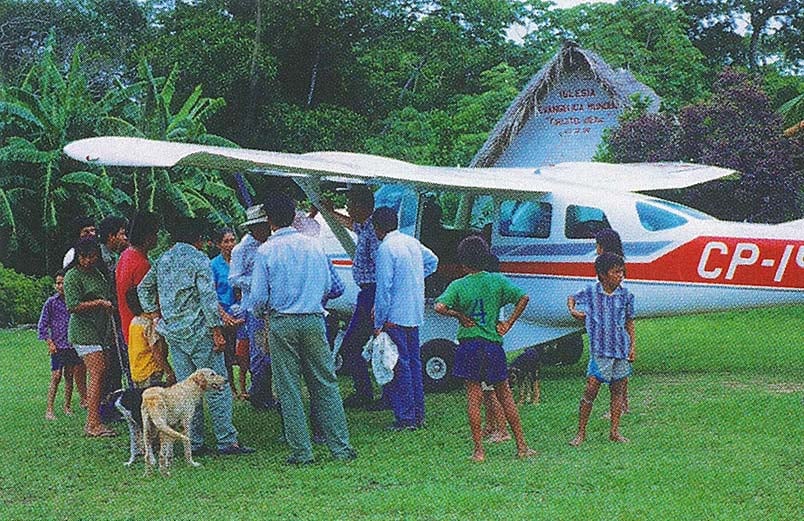
Ron Farnum visits with the villagers in front of the Cristo Viene church
During those first hours of flight training John suffered with airsickness. He often flew with one hand on the controls and the other hand holding a sick sack. But it did not deter his determination to fly. He learned quickly and his experiences working on the farm as a boy gave him sound judgment and common sense. I flew a total of 62.5 hours with John, each one a joy as I shared with him not only the skills of flying, but the skills needed to be a missionary pilot.
Masako came to Vennard College from Japan, and it wasn’t long until she and John started dating. She was a talented young lady with a deep desire to serve the Lord. When they decided to get married in 1992, they chose August 15th, our anniversary, and asked me to perform the ceremony. What a privilege to be part of this marriage, blending the cultural background of Japan with northern Minnesota.
Santa Cruz, Bolivia. 1990s.
John Trosen became good friends with John Kunkle, and their dream was to one day be missionary pilots together in Bolivia. They even shared the same birthday. I had been teaching John Kunkle to fly also; his first flight lesson was actually while sitting on my lap flying Wings of Peace as a small boy. His family lived just a 10-minute flight across the jungle from us in Bolivia, so he had grown up having an airplane as his primary mode of transportation.
These two boys and their wives enjoyed rich fellowship and dreaming together. Their common goals and prayers for each other gave them an indescribable bond.
Marion, Indiana. 1998.
John wrote me many emails in the few months he served in Bolivia. It was a joy to hear his enthusiasm for flying, his growing love of Bolivia and the people, and the adjustments with his family and cultural changes.
This was the last email I received from John:
September 24, 1998
Good evening, Ron. We had a great time with the dental team. I flew four of the members to El Carmen and Magdalena last Monday through Wednesday. One was a dentist and the rest were good assistants. We pulled several hundred teeth and had good services in the evenings at the church. Wednesday afternoon we returned to Ascensión, then the following day I flew three different members out to Manguita (mon-GE-tah), where we worked all day. It was a great experience.
Tomorrow morning we leave for Yukumo (You-KU-mo) for a weekend evangelistic campaign in the town of Palmar (Pahl-mar) where a new church is being planted by Juanito and the Yukumo church. I will take John Carlos Suazo and two seminary students, also Masako and the kids. We hope to do some teaching and activities with the children.
Bernice, please send us some Mountain Dew with the Stewards. Can’t think of anything else right now, maybe when you come in February you can bring us some stuff.
Are you going to Pine River for Christmas? That’s all for now. We love you. John
Santa Cruz, Bolivia. 1998.
Wings of Peace and her passengers started back to Santa Cruz on the two-and-a-half-hour flight on Monday morning, September 28th. At 12:56 PM, an hour and fifteen minutes into their flight, the final radio contact was made. This was the last time that John’s voice was heard.
I was asked to go to Bolivia and help with the search for CP-1528. Many nationals and missionaries had commented that John and I were so much alike in our style of flying and mannerisms that if anybody could find him, it might be me.
John’s parents had flown to Bolivia shortly after the disappearance, waiting and watching, wanting to be there when their son and his family were found. Bernice called the field director’s wife and talked with her about our arrival and lodging, requesting that we stay in John and Masako’s house, and that his parents stay there with us. They were staying at the guest house in Santa Cruz, several miles from the airstrip. The house had not been opened since the disappearance, but we knew that John and Masako would want us all to be in their home together.
On my arrival, I went directly to the hangar to meet with the Bolivian team that had already been searching for days with no success. As they reviewed the steps they had taken, I could see the weariness created by the heavy weight they had been carrying. I assured them that I could not think of even one suggestion they had not already thought of and tried. I conveyed my pride to them in the excellent response and search that was being carried out. Tom Leininger had been flying every day and was tired. I suggested he return home to Ascensión and let me fly for a few days, he needed time with his family and some good sleep.
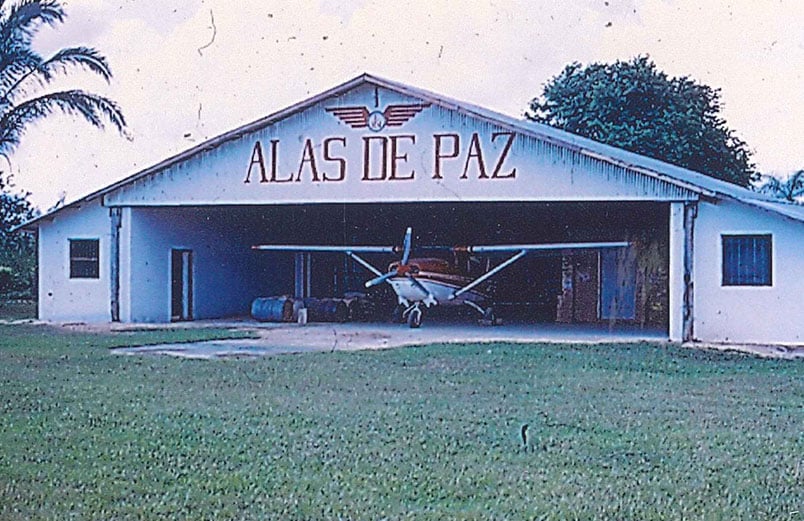
Wings of Peace hangar in Ascensión
Bernice went to the Trosen home, opening up all the doors and windows, ready to receive John’s parents. We all felt close to our missing loved ones in this place. Phyllis, John’s mother, wanted to start dusting and cleaning right away, making sure everything was ready for the homecoming. She said in Sophia and Isaiah’s rooms, looking through their clothes, toys and books, shedding many tears for her grandchildren. We cooked at Masako’s stove, laughed about some of her strange spices, loved her decorations, and felt her presence. We laughed about John’s desk and the many piles of papers, the odd assortment of shoes thrown around the closet, the signs of life in the hangar and arrangement of his tools, and the precise recording of his flights in his logbook. The Red Green videos we had sent had been well used, the fridge was left with enough food to last till their next trip to the market, everywhere were signs of life. It was one of the great privileges of this whole catastrophe, to share this time with family, to pray and search and mourn together.
Yucomo, Bolivia. 1998.
I had been praying for days in preparation for this search and really felt like I could find the missing CP-1528. I had decided to fly to Yucumo and then fly the route back to Santa Cruz, all the while trying to think like John. His dad flew with me as we followed the same route, making radio contact at the same locations, sending the weather, and noting his location at the last contact. How far one direction or the other could his fuel supply take him? What did he think about during those minutes following the contact? What had happened out here in these skies?
The nights were long for me as I lay in John’s bed, thinking about where I would fly tomorrow, wondering if it would be the day he was found, and pleading with God to let us find him.
As I flew in and out of canyons, across lush green jungle, over wandering rivers, John’s dad watched out the window, and watched and watched and watched. When the sun would dip lower on the horizon, or the fuel tanks get low indicating quitting time, he never wanted to quit. He would say, “Couldn’t we fly just a bit longer?” I could not help but see Jesus looking down and searching, just like this father. He searches for each one of us and never wants to give up. Despite the fact that we searched day after day, there were no results, except silence.
New Sharon, Iowa. 2014.
Today, in the midst of great sadness and loss, with no resolution, I choose to fix my eyes on Jesus, trusting Him totally. I want my children and grandchildren to follow the steps of Jesus, who loved and laid down His life for them. I want them to know they can trust Him, even when they do not have answers.
More Stories